
The Framework
Six pillars for turning AI investment into AI adoption.
Why We Built It
Most AI rollouts are run as technology projects with communications support attached. They fail predictably.
The CYGNAL Framework treats adoption as the central problem—and applies six interlocking disciplines to solve it. The framework was built from two decades of enterprise transformation work across Fortune 100 organizations, including Microsoft, Optum, UnitedHealthcare, Salesforce, and others.
It's the methodology we deploy in every acceleration engagement and the lens we use in every diagnostic.
What makes this approach different from generic change management:
- It's built specifically for AI, not retrofitted from ERP or M&A change methodology.
- It's communications-led, recognizing that AI adoption is fundamentally a behavior change problem solved through sustained communication.
- It treats governance, activation, and learning as core disciplines—not afterthoughts.
- Every pillar has specific instruments, deliverables, and measurement approaches.
The Framework Visualization
The six pillars work together. Strength in one pillar amplifies the others. Weakness in one pillar undermines the rest.
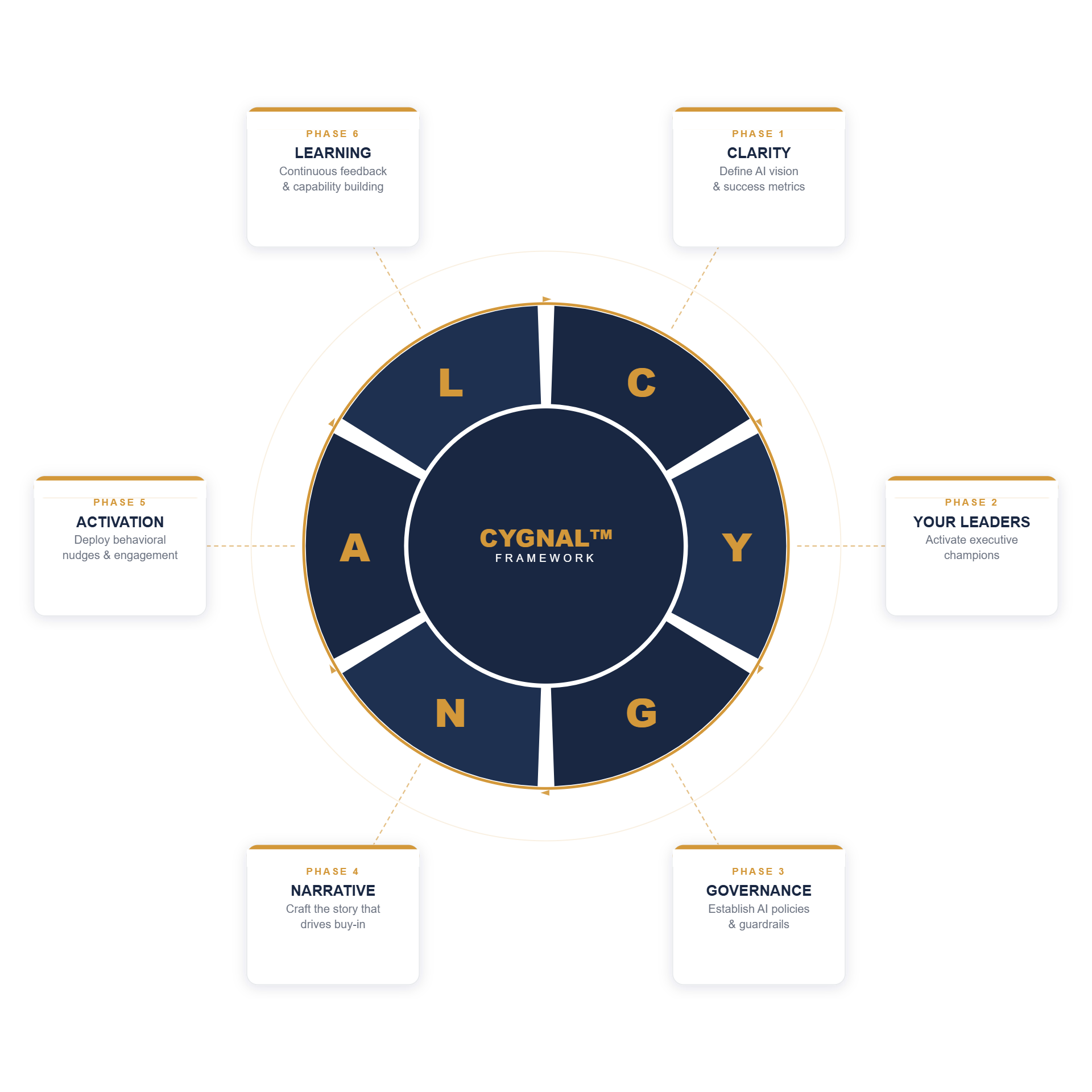
Six Pillars Deep Dive
Click on each pillar for a deeper dive into the structure.
The Pillar: Define what AI means for the organization, what success looks like, and what employees should and shouldn't expect.
The Problem It Solves: Confused messaging. Mixed signals from leadership. Employees making different assumptions about what AI is for and what it's not. The result: an organization that's officially committed to AI but operationally fragmented.
Our Approach: The CYGNAL Strategic Narrative is an executive instrument that forces alignment by asking the right questions, often the hard questions.
What You Get:
- Executive narrative platform
- One-page strategic story document
- Leader message foundation that cascades to every level
How We Measure: Pre/post executive alignment scores. Consistency of leader messaging across the organization. Employee comprehension of the strategic intent.
The Pillar: Equip leaders and managers to communicate consistently and credibly about AI.
The Problem It Solves: Executives announce AI strategically. Two levels down, managers can't answer the practical questions their teams are asking: "Will this replace my job? What can I actually use this for? What if I get it wrong?" When leaders don't translate strategy into team-level meaning, employees get a message of "AI is important" without a message of "here's what to do." Strategy without translation is just noise.
Our Approach: Leadership Cascade Toolkit—executive talking points, manager team meeting guides, layered FAQ, and an objection-handling library tailored to AI specifically.
What You Get:
- Cascade-ready messaging for three leader tiers (executive, senior manager, frontline manager)
- Manager toolkit with team-meeting guides
- Executive presence coaching for AI-specific contexts
How We Measure: Leader confidence scores on AI conversations. Manager-led team meeting completion rates. Employee pulse on "I understand my leader's view on AI."
The Pillar: Translate AI policy into employee-usable guidance.
The Problem It Solves: Most enterprise AI policy is written by some combination of legal, IT, and risk. It's correct. It's comprehensive. It's also unreadable to the average employee. The result: nobody reads the policy, and people use AI in ways they shouldn't, OR people refuse to use AI because they're afraid they'll do something wrong. The missing layer isn't more policy. It's translation.
Our Approach: The Employee Guidance Translation Protocol—a method for converting policy documents into one-page job-aid format with use-case examples, escalation paths, and plain-language do/don't guidance.
What You Get:
- Employee AI guidance materials in plain language
- Manager guidance on enforcement and gray areas
- Clear escalation paths for novel situations
How We Measure: Employee comprehension of guidance via knowledge check. Reduction in policy-related support tickets. Trend in policy-violation incidents.
The Pillar: Build a communication system that drives understanding and action — not a launch event that goes silent.
The Problem It Solves: The kickoff communication was strong. Three months later, there's been nothing. Adoption follows the silence. Adoption is sustained by repetition and rhythm, not by announcements. Most organizations don't have a communications system for AI; they have a launch.
Our Approach: The CYGNAL Communications Operating System — a 12-week rolling content calendar, channel-message matrix, and cadence rhythm designed specifically for sustained AI adoption.
What You Get:
- Editorial calendar for AI-related communications
- Message bank organized by audience and intent
- Channel strategy with cadence and ownership
How We Measure: Communication reach and engagement via channel analytics. Employee recall of key messages. Sustained communication volume over 90+ days post-launch.
The Pillar: Drive behavior change through use cases, training, and behavioral design.
The Problem It Solves: Tools are deployed without use cases. Training happens once. The behavior change doesn't. Most companies measure AI adoption by logins and licenses, not by whether work is actually being done differently. Real adoption is measured by behavior change — and behavior change requires deliberate design.
Our Approach: Use Case Activation Library — job-specific AI applications, workflow integration guides, and a peer story format that surfaces practical wins. Plus manager-led adoption rituals that build behavior into existing team rhythms.
What You Get:
- Activation playbook organized by job function
- Manager-led adoption rituals embedded in team rhythms
- Peer ambassador program design
How We Measure: Active usage rate from tool telemetry. Task-level productivity self-report. Qualitative behavior change indicators.
The Pillar: Establish feedback loops that catch adoption decay, surface emerging issues, and refine the program.
The Problem It Solves: By the time leadership notices that adoption has stalled, the curve has already bent the wrong way. Most organizations don't have feedback loops fast enough to catch adoption decay before it compounds. They run point-in-time surveys instead of continuous listening. They track usage instead of behavior.
Our Approach: The CYGNAL Adoption Pulse — a quarterly listening rhythm combining pulse survey, sentiment analysis, support-ticket trend, and tool-usage telemetry into a single Adoption Health Report.
What You Get:
- Quarterly Adoption Health Report
- Refinement recommendations based on real signals
- Executive briefing on adoption trajectory
How We Measure: Adoption trajectory vs. baseline. Sentiment trend over time. Number of identified barriers resolved per quarter.
The Framework In Action
The framework isn't a slide deck. It's a working methodology with specific instruments, templates, and deliverables for every pillar.
Engagements typically deploy the framework in one of three patterns.
Diagnostic (2–3 weeks)
We assess all six pillars to identify where the breakdowns are or will be, prioritize what to address first, and produce a roadmap. Most engagements start here.
Acceleration (6–12 weeks)
We deploy the framework end-to-end, with deeper concentration on the 2–3 pillars where the highest-leverage work is needed. This is the flagship engagement.
Advisory (ongoing)
We sustain framework execution post-launch through a monthly cadence — typically focused on Narrative, Activation, and Learning to prevent adoption decay.